
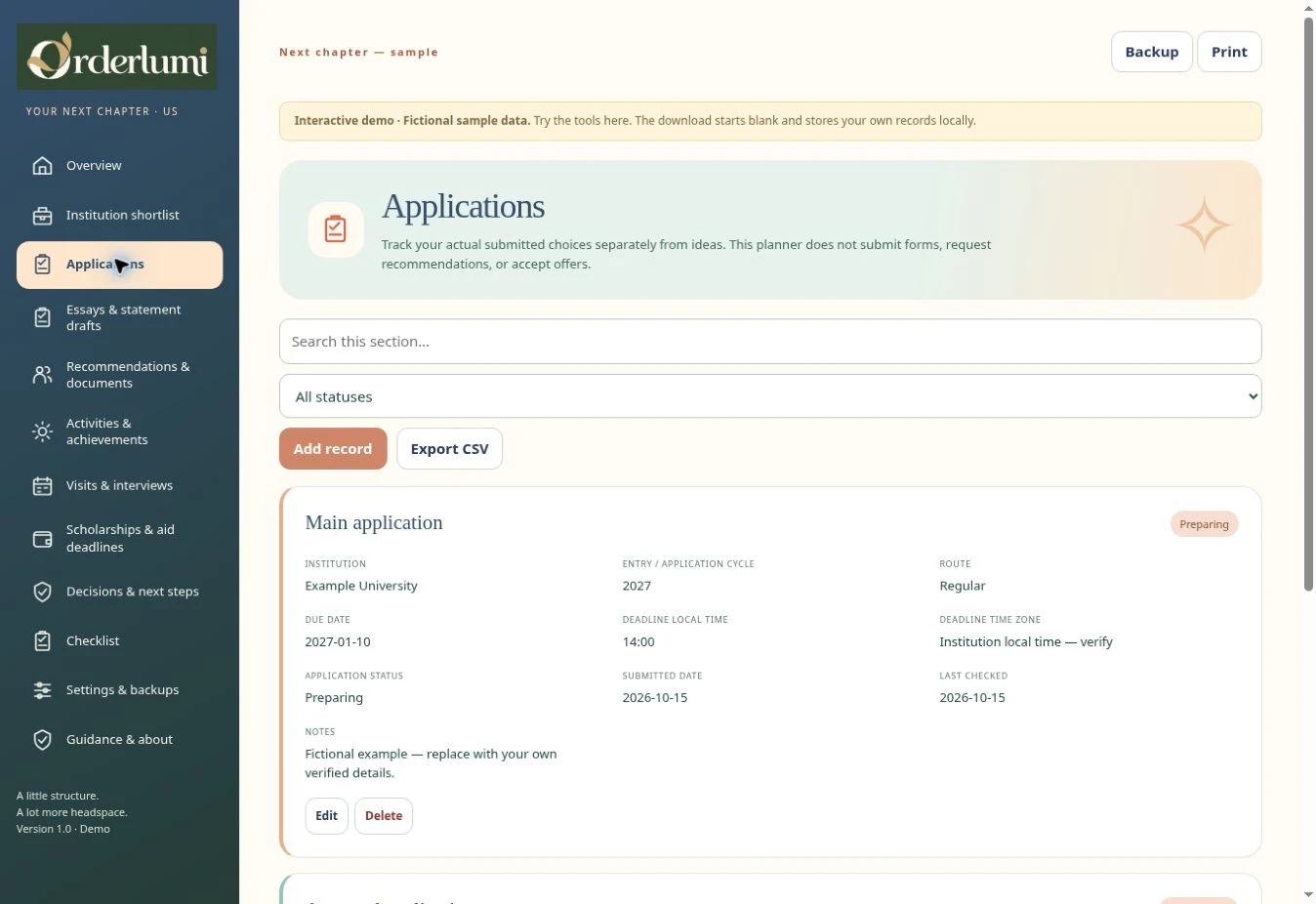
Updated 14 October 2026. This guide is educational planning advice. Check current official requirements, dates and eligibility before acting.
1. Build a balanced college shortlist
Research academic programmes, accreditation where relevant, setting, class sizes, student support, admission requirements, tuition and estimated total cost. Include ambitious, likely and financially workable choices without treating admission as predictable. Record every college's official admissions site.
2. Track each college's application route and deadline
Schools may use the Common App, their own application system or another service. Early Action, Early Decision, Restrictive Early Action, Regular Decision and rolling admissions are not interchangeable. Record the actual round offered by each school and its official deadline; Early Decision may involve a binding agreement, so check the college rules before selecting it.
3. Build the information and documents list
List transcript arrangements, school reports, counsellor forms, recommendations, test-score rules, English-language requirements where applicable, portfolios and supplements. A college may be test-optional for one programme or cohort but not another. Verify directly rather than copying an older internet checklist.
4. Draft essays and supplements with time to revise
Start with an inventory of genuine experiences, values, curiosity and growth. Outline the main essay and each college-specific prompt separately, then revise for relevance and your own voice. Do not recycle a generic “why this college” response without research. Leave ample time for proofreading and trusted feedback.
5. Request recommendations and school documents early
Choose recommenders who can speak specifically to your work, give them a clear, respectful briefing and an accurate deadline, and confirm the submission method. Follow up courteously. Keep track of whether your school has sent the transcript and other reports.
6. Plan financial aid as a separate workstream
Research the Free Application for Federal Student Aid (FAFSA), institution-specific forms and scholarships. The 2027–28 FAFSA is available for eligible students seeking aid for July 2027 through June 2028, but federal, state and college priority deadlines differ. Some colleges require additional forms, such as the CSS Profile, and individual scholarship deadlines may be earlier. Check each official financial-aid office.
7. Submit and monitor every portal
Review legal name, programme choice, essays, fees or waivers and supporting documentation. Save confirmation numbers and check applicant portals for incomplete materials, interview notices and requests. A submitted application may still be missing external documents.
8. Compare admission and aid offers
Separate the sticker price from grants, scholarships, work-study and borrowing. Estimate realistic net cost for each academic year, including housing, travel, food and supplies. Compare course quality, support, conditions, aid renewal rules and campus fit. Check each college's acceptance and deposit deadlines, and any restrictions attached to an early programme.
9. Plan for waitlists, deferrals and the final decision
Read school-specific instructions for waitlists or deferrals and submit only permitted updates. Maintain a viable alternative while awaiting a decision. After choosing, complete enrolment, housing, orientation and financial-aid actions on the official portal.
Official sources and further reading
Different courses, schools and applicants may have different rules. If a date or requirement in an article conflicts with your official application portal, follow the official source.